
• Home
  • About M.O.M.
    • About Joscelyn
    • Contact
    • Disclosure Policy
    • Partner With Mami Innovative Media
  • Contributors
    • Writers, Bloggers, Contributors & Guest Posts Welcomed
    • christine goulbourne
  • How To Work With Us
    • Have Joscelyn Speak at Your Next Event
    • Work with Joscelyn as an On-Air Spokesperson and Brand Spokesperson
  • Press
  • Speaking
  • Schedule a meeting
    • Amazon
    • Facebook
    • Instagram
    • Pinterest
    • Threads
    • Twitter
    • YouTube

Mami of Multiples

  • education
    • back to school
  • entertainment
  • family
    • beauty
      • health
    • family outing
    • holidays
    • latinos
      • latina magazine
    • military
    • multiples
    • parenting
    • reviews
    • savings
    • shopping
    • technology
  • inspirational
  • giveaways
    • twitter parties
  • recipes
    • easy recipes
  • special needs
    • autism spectrum disorder
  • travel
    • summer guide
      • summer fun
      • summer learning

Grading History: A Review of the Smithsonian’s First-Ever Latino History Exhibit

PRESS RELEASE - Thu, 23 Jun 2022 19:39:42

By Manny Ruiz MIAMI, FL — June 23, 2022 — (NOTICIAS NEWSWIRE) — The history of Latinos in the U.S. is a complex one that encompasses more than 20 nationalities and territories and spans centuries, colonial conquests, slavery, forced migrations, and an ongoing struggle to be seen and heard. Compressing this rich story into just …
SOURCE: NOTICIAS NEWSWIRE

By Manny Ruiz

MIAMI, FL — June 23, 2022 — (NOTICIAS NEWSWIRE) — The history of Latinos in the U.S. is a complex one that encompasses more than 20 nationalities and territories and spans centuries, colonial conquests, slavery, forced migrations, and an ongoing struggle to be seen and heard.

Compressing this rich story into just 4,500 square feet of exhibit space is everybody’s definition of impossible.  And yet, that’s what the Smithsonian has achieved with its first-ever Latino exhibition, “Presente! A Latino History of the United States,” which debuted Saturday.

Housed inside the new Molina Family Latino Gallery at the American History Museum in Washington, DC, the immersive, bilingual exhibit is a precursor to a future National Museum of the American Latino.  It’s expected to take ten years or so to fundraise for and build the estimated $700 million Latino Smithsonian.

We had a chance to tour the gallery before its public unveiling, and, in general, it’s an impressive first effort with some understandable holes to complete.  Here’s a look at what we think works — and doesn’t — at this ambitious exhibit that largely draws several hundred articles and items from the Smithsonian’s own collections.

Technology is creatively embraced — and its possibilities are exciting

While Latinos may be frustrated that the Smithsonian took so long to honor our history, this delay is certainly going to reap one huge benefit: our future museum will feature the most state-of-the-art tech.  That’s the first impression you get when you walk into the gallery.  Much the way mirrors make spaces look bigger, tech walls and kiosks not only visually decorate the gallery but also extend the exhibit’s storytelling with immersive videos, and photos.

The tech is not just visual either.  At an emotional Cuban raft display, visitors are invited to press a button that simulates the scent of ocean water.  A domino-playing exhibit features the aroma of fresh-brewed coffee, and a bread-making display triggers the scent of fresh bread.  These clever multisensory details create many exciting possibilities for the future when curators will be able to design history that leverages other tech like augmented reality.

One of the largest digital displays you’ll find in the gallery’s multimedia plaza, El Foro (The Forum), is devoted to informing the public about the size, demographics, trends, and distribution of the U.S. Hispanic community.  It’s a curious Hispanic 101 integration into the show that seems necessary given how overlooked and misunderstood our community still is today.

An Inclusive Exhibit Featuring ‘Many Latinos’

Given many sensitivities about recognition in our Latino communities, being inclusive and fair to the entire Hispanic cohort at a museum like this is one of those areas that if not skillfully handled could cause consternation and controversy among some.

Fortunately, in this regard, the Smithsonian has nothing to worry about. Despite — by their own admission — not being able to feature every single nationality, the inaugural program shows good faith in integrating as broad a spectrum of people and objects as possible from almost every sector of the Latino experience.

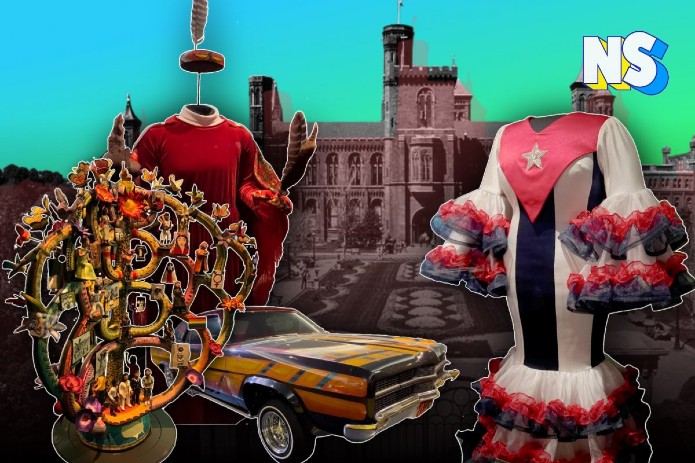
You could see that the Smithsonian was heading in this inclusive direction before the gallery opened.  They made that statement the moment they chose the Cuban flag dress of Afro-Latina Salsa Queen, Celia Cruz to become the featured historic object of all their marketing materials.  And while our beloved Celia serves as the gallery’s spiritual godmother (Selena would have been another great choice), the Smithsonian goes much further than that when representing Afro-Latinos.  Afro-Latinos are prominently highlighted in displays about slavery, their early rebellions, and even through the civil rights efforts of baseball star Roberto Clemente, who makes a few cameos.

The Latino LGBTQ community is also well represented in the gallery.  On exhibit, for example, is a stunning blue dress that belonged to legendary drag performer and activist José Sarria, who in 1961 became the first openly gay person to run for public office in U.S. history.

The gallery’s Somos Theater itself is sponsored by entrepreneur and activist Henry R. Munoz III, who chairs the Smithsonian’s National Museum for the American Latino board of directors, and who for decades has been one of the museum’s most powerful champions.  One of the gallery’s digital displays also features an interview with Ruby Corado, founder of Casa Ruby, a bilingual LGBTQ community center in Washington.

The Exhibit is Deep on Struggles but Lite on Cultural Contributions

In Presente, the Smithsonian does a great job of expertly knitting together how our various Latino communities arrived where they are today. They achieve this through brisk storytelling that discusses many historic periods.  The museum gives us a snapshot of pre-colonial indigenous America, the Spanish conquest of the Americas, slavery, the birth of Mexico, the Mexican-American War, Puerto Rico’s annexation, U.S. interventions in the Americas, the Cuban exodus from Fidel Castro’s Revolution, the Farmworker Rights Movement, and more.

Unfortunately, as interesting and necessary as this part of our Latino story is, it feels like the museum focuses too much of its limited space on our communities’ numerous struggles and not enough on our cultural contributions.

While our historic battles, national and international, are important,  with this inaugural gallery, curators should have better balanced our struggles with our community’s fun cultural roots so it doesn’t feel as “heavy” as it often does.

For example, Puerto Rico’s contributions to music genres like Salsa, Latin Jazz, and Reggaeton were a simple, obvious opportunity to integrate a fun pop-up display.  An even bigger miss was not creating a standalone display for Celia and Roberto Clemente, two cultural icons with universal appeal, who would have been much better for the gallery than the large exhibit space the museum devotes to an old printing press that wasn’t even directly involved in publishing the first Latino newspapers.  (The printing press belongs in a much larger Latino Smithsonian).

NBC News reports that in two years, the next Smithsonian Latino exhibit will focus on “youth activism and empowerment.”  That’s a noble idea but would be a huge mistake because it would follow the same “struggles” theme of the current exhibit.  What the masses need to see next are joyful, cultural stories.   That’s what moves people’s hearts and minds.  (Just ask the American History Museum what their No. 1 draw is: Dorothy’s red ruby slippers from The Wizard of Oz).

Other Standout Pieces at The Molina Gallery

Even though history museums can sometimes overuse modern art pieces to fill in for original items they lack, there is one terrific exception to that at the Molina Gallery: the Tree of Life.  Created by third-generation ceramic artist Verónica Castillo, this gorgeous artwork features small ceramic pieces representing the groundbreaking Latinos and Latinas that are part of the first exhibit, including the first Latina astronaut Ellen Ochoa, baseball star Mariano Rivera, and even Dr. C. David Molina, whose philanthropic Mexican American family donated more than $10 million toward creating the gallery.

You also don’t want to miss the “Dave’s Dream” 1969 Ford LTD Lowrider that the museum has parked in the lobby of the American History Museum to “drive” visitors to the Molina Gallery.  This whimsically illustrated car is symbolic of the importance of lowrider culture among Mexican Americans and is named for the late David Jaramillo of Chimayo, New Mexico, who began customizing it in the 1970s and won several “first” or “best in show” awards with it in area competitions.  (This vehicle also definitely belongs in the future museum).

The Latino vs. Latinx vs. Hispanic Debate is Settled — Sorta

One of the more curious parts of the exhibit is that the Smithsonian felt compelled to explain with a large sign why the gallery variously alternates between using the words Latino, Latinx, and Hispanic. The museum wisely settles this debate by informing visitors that they will allow people featured in the gallery to self-identify however they prefer, including by their gender and nationality. 

Telling the Cuban, Salvadoran, and Nicaraguan Exodus Stories

The Smithsonian doesn’t flinch in documenting our nation’s role in directly and/or indirectly triggering political conflicts that at times led to several historic mass exoduses to the U.S. from countries such as Nicaragua, and the Dominican Republic, Cuba, and El Salvador.

It also doesn’t give the Castro Brothers’ dictatorship in Cuba any cover, which will be a huge sigh of relief to many Cuban exiles who sometimes wonder if other Latinos notice that the Castro Dictatorship has been going strong for 63 years.  Even though the museum doesn’t make any direct statements against the Castros, they actually tip their hats to Cuban exiles – maybe all exiles - by prominently exhibiting the tiny wooden raft that two Cuban refugees used to reach the U.S.

In this gallery, the raft transforms into an eloquent and universal symbol of the grit and determination that drive many Latino immigrants to reach our shores and borders in search of freedom and opportunities.

What’s Next

If every journey begins with a single step, the Molina Gallery is not merely a step.  It’s a giant leap for Latinos, and a tribute to the Molina Family, Muñoz, leaders of the FRIENDS of the American Latino Museum, a cadre of bipartisan elected officials in the Senate and Congress, as well as countless others who spent almost three decades lobbying Congress to pass a bill enabling this museum to raise the funds to be built.  Expectations are also high after the Smithsonian made the great move to appoint Jorge Zamanillo, a gifted leader who led HistoryMiami as the Founding Director of the National Museum of the American Latino.

The next phase for the museum is on a location to build it and the consensus is that it will be announced towards the end of this year or the very beginning of 2023.   From private advocacy meetings we witnessed with many, including Republican and Democratic leaders, there is a very strong chance that the site will be on the National Mall.  That’s the hardline position that the FRIENDS of the American Latino Museum, Muñoz, and others Latino leaders are taking, and it is absolutely right because Latino history is American history, and this museum deserves to stand “shoulder to shoulder” with the other great Smithsonians.

If you want to visit the museum virtually, you can see many parts of the gallery online at the exhibit’s website, https://latino.si.edu/.  In addition to featuring more in-depth information about different parts of the museum, you can use the website to make a donation towards the construction fund for the building at this link.

By Manny Ruiz

Manny Ruiz is the Publisher, Co-Founder, and Chief Historian of Nuestro Stories, which is the flagship media property of Brilla Media Ventures.  The founder and former CEO of Hispanicize, and Hispanic PR Wire, Manny is a serial entrepreneur who began his career as a crime reporter for The Miami Herald.  Manny holds a Bachelor of Arts degree in History from Florida International University.


As Seen On

Catch Us In The News

Dr. Joscelyn Ramos Campbell Is Named A Top Latina Mom Blogger For 2026

Watch the full reel on Instagram.

Founder Of Hope Torchlighters, Dr. Joscelyn Ramos Campbell, And The City Of Groveland, FL Partner On The City's First Sensory Friendly Easter Egg Hunt!

Watch the full video on YouTube.

Dr. Joscelyn Ramos Is Honored As One Of The 2026 Women Of Impact Award Recipients At The Annual Mood-Setter Social

Read the full story.

Dr. Joscelyn Ramos Campbell Awarded with The Presidential Lifetime Achievement Award of Service

Read the full story on Noticias Newswire.

Return of the Mommy Blogger: Top Mom Blogs Offer Brands SEO Content

Read this post on LinkedIn.

Telemundo’s Mujeres Imparables

Read the full story on Noticias Newswire.

Marketing Outstanding Leadership Award

Top Disability Advocate

Chicas Chatting Podcast


Popular Posts


Instagram

drjoscelynramoscampbell

2,519

🏆 Presidential Lifetime Achievement Award
🎤 Media Spokesperson
📺 Seen CBS • NBC • FOX • Telemundo
💛 Founder @hopetorchlighters
♿ Inclusion Advocate

drjoscelynramoscampbell

View Instagram post by drjoscelynramoscampbell

Oct 11

Open post by drjoscelynramoscampbell with ID 17960778569997646
💙 Joshua, my sweet and gentle soul. My dance partner and superhero. You are everything. 
 
 #mommysbabyboy #boymom #autism #autismacceptance

💙 Joshua, my sweet and gentle soul. My dance partner and superhero. You are everything. 
 
#mommysbabyboy #boymom #autism #autismacceptance
...

64 1

drjoscelynramoscampbell

View Instagram post by drjoscelynramoscampbell

Oct 7

Open post by drjoscelynramoscampbell with ID 18114581159585354
We have one life. Live it. 🌎 ♥️ #Godfirst #bekind #helpothers #selfcare

We have one life. Live it. 🌎 ♥️ #Godfirst #bekind #helpothers #selfcare ...

38 1

drjoscelynramoscampbell

View Instagram post by drjoscelynramoscampbell

Sep 17

Open post by drjoscelynramoscampbell with ID 18213438070337190
🇺🇸🇨🇺🇵🇷🗽 What a way to begin Hispanic Heritage Month and commemorate 25 years since 9/11 in New York.

Thank you to everyone who has read, commented, and shared. This story has now reached around 2 million people across platforms and traveled around the world.

This trip became an emotional homecoming. People traveled to New York not only to remember, but to return pieces of my family’s history.

The most precious was a photograph of Dad and me during my first summer working in his office on the 19th floor of the South Tower. We believed it was lost forever on 9/11. Ms. Carole, one of Dad’s secretaries—whom he helped survive that day—had kept a duplicate. After her passing, her grandson Frankie found it, along with my World Trade Center pass marked 2/19 (South Tower, 19th Floor). I’ve now been asked to submit this history to the National September 11 Memorial & Museum.

I also learned more about Dad’s life: my Cuban father was an early supporter and organizer of the National Puerto Rican Day Parade; his baseball career led to ceremonial first pitches; and in 1972 he received the American Heritage Award during a “Spanish Night” in New York. In 2025, I received the Presidential Lifetime Achievement Award—continuing the legacy of service Mom and Dad began.

Agent Lee shared another chapter: when his family’s Chinatown restaurant was targeted by anti-Asian violence, my parents helped bring the community back—and I, a little girl in a She-Ra shirt, worked beside them asking, “What would Jesus do?” His family called me their 貴人 (Guìrén): a benefactor who arrives at the right moment.

The white suit and black dress I wore in New York belonged to Mom. Wearing them felt like carrying her with me.

As an only child, it has been my greatest honor to have always been by my late parents' side throughout my life and to care for them in their final years. I’m humbled that this story has connected us across different generations and borders.

Thank you for reminding me: “You might be far, but you are never forgotten.”

John 13:34–35 | Jeremiah 29:11

#NeverForget #September11 #HispanicHeritageMonth #Legacy #DrJoscelynRamosCampbell

🇺🇸🇨🇺🇵🇷🗽 What a way to begin Hispanic Heritage Month and commemorate 25 years since 9/11 in New York.

Thank you to everyone who has read, commented, and shared. This story has now reached around 2 million people across platforms and traveled around the world.

This trip became an emotional homecoming. People traveled to New York not only to remember, but to return pieces of my family’s history.

The most precious was a photograph of Dad and me during my first summer working in his office on the 19th floor of the South Tower. We believed it was lost forever on 9/11. Ms. Carole, one of Dad’s secretaries—whom he helped survive that day—had kept a duplicate. After her passing, her grandson Frankie found it, along with my World Trade Center pass marked 2/19 (South Tower, 19th Floor). I’ve now been asked to submit this history to the National September 11 Memorial & Museum.

I also learned more about Dad’s life: my Cuban father was an early supporter and organizer of the National Puerto Rican Day Parade; his baseball career led to ceremonial first pitches; and in 1972 he received the American Heritage Award during a “Spanish Night” in New York. In 2025, I received the Presidential Lifetime Achievement Award—continuing the legacy of service Mom and Dad began.

Agent Lee shared another chapter: when his family’s Chinatown restaurant was targeted by anti-Asian violence, my parents helped bring the community back—and I, a little girl in a She-Ra shirt, worked beside them asking, “What would Jesus do?” His family called me their 貴人 (Guìrén): a benefactor who arrives at the right moment.

The white suit and black dress I wore in New York belonged to Mom. Wearing them felt like carrying her with me.

As an only child, it has been my greatest honor to have always been by my late parents` side throughout my life and to care for them in their final years. I’m humbled that this story has connected us across different generations and borders.

Thank you for reminding me: “You might be far, but you are never forgotten.”

John 13:34–35 | Jeremiah 29:11

#NeverForget #September11 #HispanicHeritageMonth #Legacy #DrJoscelynRamosCampbell
...

118 1

drjoscelynramoscampbell

View Instagram post by drjoscelynramoscampbell

Sep 11

Open post by drjoscelynramoscampbell with ID 18024691334699209
🇺🇸 My Father Survived 9/11—But 9/11 Ultimately Took His Life.

🇺🇸 Twenty-five years ago, my father, José Quintero Ramos, was on the 19th floor of the South Tower when the North Tower was struck. Dad had survived the 1993 World Trade Center bombing and knew something was wrong. He insisted his secretaries and coworkers leave. Holding hands, they formed a human chain and began descending the stairs.

🇺🇸 Then the second plane struck their tower.

🇺🇸 The lights went dark. Smoke, ash, and debris filled the hot stairwell. Dad gave others the handkerchiefs he always carried so they could breathe, leaving only his arm to cover his own face.

🇺🇸 As firefighters and first responders climbed upward, Dad thanked them and squeezed their shoulders. One young firefighter rested his face in Dad’s hand—like a son receiving a father’s blessing. Dad never saw him again.

🇺🇸 Dad and his coworkers escaped and crossed the street only moments before the South Tower collapsed at 9:59 a.m. Those with him later said they would not have survived without his insistence. His courage saved lives.

🇺🇸 For more than ten hours, we did not know whether he was alive.

🇺🇸 Covered in ash, blood, and cuts, he walked for hours across the Brooklyn Bridge to the Cathedral Basilica of St. James, where I was baptized. A priest wiped his face, embraced him, and prayed.

🇺🇸 Our family was blessed with nearly 19 more years—but Dad was never the same. He ultimately died from respiratory failure caused by the toxic air he breathed that day. He is now officially recognized as a 9/11 victim.

🇺🇸 On this 25th anniversary, I remain honor-bound as his daughter to tell his story—especially as 9/11 moves from living memory into history.

🇺🇸 9/11 did not end on September 11, 2001. Its toll continues whenever another survivor or responder dies from a related illness.

🇺🇸 May we remember those lost that day, those lost in the years since, and everyone still suffering.

🇺🇸 Daddy, your courage lives on. We will never forget. 🤍🕊️

🔗 https://bit.ly/JoseQRamos

#JoseQuinteroRamos #NeverForget #September11 #RIPDaddy
...

213 5

drjoscelynramoscampbell

View Instagram post by drjoscelynramoscampbell

Sep 10

Open post by drjoscelynramoscampbell with ID 18137137450720512
🗽 🇺🇸 Daddy, I’ve returned to our home state to represent you at both private and public official 25th anniversary September 11th remembrance events in New York. 
🗽 🇺🇸 Your little girl is traveling solo, but safeguarded at each event by a private security team that has been prearranged for me—just another example of God’s favor and how our (good) reputation has preceded us. 
🗽 🇺🇸 It’s a reaffirmation of your protection over me still and a nostalgic reflection of the times when we all traveled together during our careers. 
🗽 🇺🇸 It is my honor to continue being your daughter and to carry the legacy. 🤍🕊️
#NeverForgot #NewYork #MyHome #WorldTradeCenter #newyorkcitygirl

🗽 🇺🇸 Daddy, I’ve returned to our home state to represent you at both private and public official 25th anniversary September 11th remembrance events in New York.
🗽 🇺🇸 Your little girl is traveling solo, but safeguarded at each event by a private security team that has been prearranged for me—just another example of God’s favor and how our (good) reputation has preceded us.
🗽 🇺🇸 It’s a reaffirmation of your protection over me still and a nostalgic reflection of the times when we all traveled together during our careers.
🗽 🇺🇸 It is my honor to continue being your daughter and to carry the legacy. 🤍🕊️
#NeverForgot #NewYork #MyHome #WorldTradeCenter #newyorkcitygirl
...

73 0

drjoscelynramoscampbell

View Instagram post by drjoscelynramoscampbell

Sep 6

Open post by drjoscelynramoscampbell with ID 18077096033378549
🤍 🇨🇺 🇺🇸 🕊️ Grief and Daddy’s Little Girl.

Daddy, six years ago today, you entered eternity. Your courage on 9/11 helped others survive but ultimately cost you your life. You are now officially recognized among its victims.

Mommy passed in January. Nine months later came my MS diagnosis. A year later, on September 6, I lost you—five days before 9/11. Oh, September. We used to be friends because of fall and all things pumpkin. Not anymore.

This photo takes me back outside St. Patrick’s Cathedral. You were about to speak beside Rev. Jesse Jackson at a rally for 7,000 workers displaced by sugar refinery closures. I was seven. You handed me the mic, and I joked that kids loved sugar, families needed jobs, and we had to “keep hope alive.” I only wanted to make you proud—and get the steak sandwich and ice cream you’d promised near the World Trade Center.

Grief doesn’t take a holiday. “The death of a beloved is an amputation.” —C.S. Lewis

My parents taught me to serve and bloom where God planted me. Joshua’s special-needs diagnosis turned my grief into advocacy and a nonprofit for families. Service is our legacy and biblical calling.

But the Church must do better after loss—not only at funerals, but through the months, years, birthdays, and anniversaries. Grief is lifelong, not a race. Heaven doesn’t erase how deeply we miss their presence. Shepherding means calling, listening, and showing up so no one feels invisible or alone.

To those touched by how I honor my parents, thank you. To anyone grieving a loved one, disability, or special-needs parenting: I see you. You’re not alone. Jeremiah 29:11.

To the sweet mama in the UK: throw the plates if you need to. Jesus wept. Jesus got angry. He understands. Call me.

I know Mommy and Daddy are proud, yet my heart and soul are heavy. As the 25th anniversary of 9/11 approaches, I’ll go to NYC alone to honor Daddy.

Te amamos para siempre. 🤍

P.S. If anyone hears the rapture trumpets while I’m gone, tell God I have a VIP Express ticket—and I don’t mind pushing a few people out of the way. 🥹😇😂

#WeLoveAndMissYouDaddy #WeLoveAndMissYouPapa #WeWillSeeYouAgain
...

129 0
Follow on Instagram
Noticias Newswire

Grading History: A Review of the Smithsonian’s First-Ever Latino History Exhibit

By Manny Ruiz MIAMI, FL — June 23, 2022 — (NOTICIAS NEWSWIRE) — The history of Latinos in the U.S. is a complex one that encompasses more than 20 nationalities and territories and spans centuries, colonial conquests, slavery, forced migrations, and an ongoing struggle to be seen and heard. Compressing this rich story into just …

View More

Dr. Joscelyn Ramos Campbell Honorary Doctorate Ceremony

Copyright © 2026 · glam theme by Restored 316

Copyright © 2026 · Glam Theme on Genesis Framework · WordPress · Log in